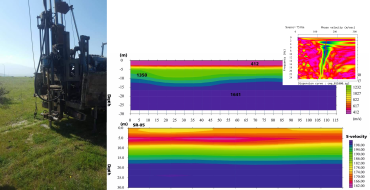
In geotechnical engineering, the ground on which engineering structures (buildings, dams, roads, tunnels, etc.) are built is as important as the structures themselves. A structure must be designed according to its ground conditions to perform safely and adequately.
Using current equipment and software, we determine the engineering parameters of the site’s soil (bearing capacity, dynamic and elastic properties, strength, etc.), groundwater presence, liquefaction potential, geological structure, and potential fault/fracture systems. Our work also covers geological and geotechnical studies for zoning plans and soil improvement projects.
Electrical Methods (VES and ERT)
Vertical electrical sounding (VES) investigates how subsurface resistivity changes with depth; 2D and 3D electrical resistivity tomography (ERT) maps its lateral and vertical distribution.
P-Wave Refraction
Analyzes the propagation and refraction of compressional (P) waves through layers with different seismic velocities. It is used to estimate P-wave velocity (Vp), identify layer boundaries, and characterize near-surface conditions — in foundation investigations, groundwater studies, and the differentiation of fill, weathered materials, and bedrock.
MASW
A near-surface seismic method that analyzes Rayleigh surface waves to determine the shear-wave velocity (Vs) profile. Typically acquired with 12–24 geophones, it supports layer characterization, seismic site classification including Vs30, and ground improvement monitoring.
ReMi (Refraction Microtremor)
A passive method that uses ambient vibrations from traffic, wind, and industrial activity instead of an active source. Like MASW, it estimates Vs profiles and is particularly suitable for urban environments where ambient noise is readily available.
Ground Penetrating Radar (GPR)
A non-invasive electromagnetic method that transmits high-frequency waves into the ground and records their reflections. Used for infrastructure and route surveys, void detection, and archaeogeophysics.
Microtremor Surveys
Very low-amplitude ground vibrations from sources such as wind, ocean waves, traffic, and industrial machinery are recorded with sensitive seismometers.
Downhole, Crosshole and Uphole
In the Downhole method the source is at the surface and the receiver at different depths in a borehole; P- and S-wave arrival times give the velocity profile. Crosshole uses at least two closely spaced boreholes to determine velocities between them with high accuracy. Uphole places the source in the borehole and the receivers at the surface.
Pile Testing
Field tests that evaluate the load-bearing capacity, structural integrity, and soil–structure interaction of deep foundation elements: static load tests, dynamic load testing (PDA), pile integrity testing (NDT), and pile instrumentation and monitoring.
Hybrid 2D Seismic Acquisition and Processing
Combines active- and passive-source seismic techniques to obtain high-resolution 2D images of the subsurface, overcoming some limitations of a single acquisition technique while improving depth of investigation and optimizing field costs.